Shedding Light on DALI
How do we achieve perfect lighting control in modern commercial spaces while keeping everything simple and efficient? For many years, that’s been the key challenge for lighting designers, architects, and installers across the UK. Traditional systems often gave us either reliability or flexibility, but rarely both. As buildings have become smarter and energy performance has climbed higher up the agenda, the demand for a truly intelligent, future-proof lighting control system has only increased.
This is where DALI steps in. The Digital Addressable Lighting Interface, better known as DALI, has become the gold standard for lighting control across Europe and beyond. It solves the very problems that older systems struggled with, offering commercial-grade reliability, scalability, and unrivalled control – all while making installation and commissioning much simpler.
In this post, we’re going to explore exactly what DALI is, why it’s so important for UK lighting projects, and the benefits it brings in real-world applications. From precision dimming to full colour control, from individual fixture adjustments to entire group programming, we’ll show you why DALI has become the go-to solution for professional LED installations.
What is DALI?
DALI stands for Digital Addressable Lighting Interface. It is not a brand name or a product line, but an open international standard (IEC 62386) that defines how lighting devices communicate with each other. In simple terms, DALI provides a universal language for lights, drivers, and controllers to talk to each other, regardless of manufacturer.
This is a huge advantage for specifiers and installers here in the UK. Rather than being locked into one proprietary system, we can design a project using DALI-compatible products from multiple suppliers, confident that they will work seamlessly together. It is this interoperability that has made DALI the backbone of so many professional lighting systems – from retail and hospitality to schools, hospitals, and government buildings.
DALI replaces older analogue control methods like 1–10V dimming. Where analogue systems could only give a general dimming signal, DALI provides digital, addressable control, meaning each fixture can be individually programmed and adjusted. This is the foundation for the advanced features we’ll discuss throughout this article.
Commercial Grade – Built for Professional Projects
When we talk about DALI being “commercial grade,” we’re referring to the way it has been designed from the ground up for professional applications. Unlike basic consumer-level systems, DALI is robust, reliable, and highly scalable. It’s the reason why you’ll find it in so many offices, retail stores, universities, and public sector projects across the UK.
Because DALI is an international standard, it has undergone rigorous development and testing to ensure compliance with safety and performance expectations. This isn’t a closed ecosystem controlled by one company – it’s a technology that the entire lighting industry has invested in. That gives us confidence, as installers and designers, that the systems we put in place today will remain supported for years to come.
Another advantage is integration. DALI works hand in hand with building management systems (BMS), allowing lighting to be controlled alongside HVAC, security, and other building services. For facilities managers, this means one centralised platform for energy efficiency and automation. It’s also a key reason why DALI has been embraced in new-build projects striving to meet strict energy regulations and sustainability targets.
To put it into perspective, studies suggest that DALI is now specified in the majority of new commercial lighting installations across Europe. In the UK, its adoption has accelerated particularly in government-funded projects, where compliance and long-term reliability are non-negotiable.
Simplicity of Installation
One of the most attractive features of DALI for contractors is how simple it is to install. Traditional systems often involved a maze of control cables, relays, and complex wiring schemes. DALI reduces this dramatically with its two-wire bus system.
This bus carries both power and data, allowing fixtures and controllers to be connected in a straightforward daisy-chain or star configuration. There’s no need to run separate control wiring for each zone, and there’s no polarity to worry about. This immediately reduces the risk of wiring errors and saves significant installation time.
For UK electrical contractors, time is money. Projects are often under pressure to meet tight deadlines and delays due to complicated commissioning can be costly. DALI simplifies this by enabling quick addressing and configuration. With the right software or handheld tools, fixtures can be added, grouped, or adjusted with ease.
We’ve seen time and again how this simplicity translates to real savings for clients. Fewer components mean lower material costs, and faster commissioning means projects can be completed on schedule without compromising on quality. For many contractors, once they’ve worked with DALI, they don’t want to go back to anything else.
Precision Dimming
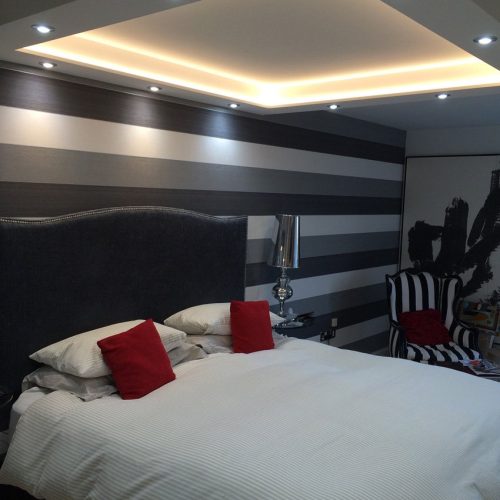
One of DALI’s strongest features is its ability to deliver precision dimming. Unlike older analogue systems, which could be inconsistent or suffer from flicker at low levels, DALI provides smooth, flicker-free dimming all the way down to less than 1% output.
This is critical in environments where lighting quality directly affects the experience. In a high-end restaurant, for instance, we want the ability to fine-tune ambience without distracting flicker. In a gallery or museum, we need to highlight delicate artworks with exact control over light intensity. In offices and classrooms, precise dimming contributes to both energy efficiency and user comfort.
Compared to phase-cut or 1–10V dimming, DALI is far more reliable and predictable. Each fixture responds to digital commands with accuracy, ensuring uniform dimming across an entire installation. This means no more situations where one fitting looks slightly brighter than another at low levels – everything stays perfectly consistent.
And of course, precision dimming also supports energy savings. By tailoring light output to the exact needs of the moment, we avoid wasting energy on unnecessary brightness. Over the lifetime of a commercial building, these savings can be substantial.
Colour Control
Lighting isn’t only about brightness; it’s also about colour. With modern LED technology, we can create tunable white lighting that shifts from warm to cool, or dynamic RGBW lighting that introduces vibrant colour effects. DALI fully supports this level of control.
Using DALI, we can programme scenes that adapt to different uses of a space. In offices, tunable white lighting can be set to mimic natural daylight cycles, supporting circadian rhythms and boosting productivity. In retail, colour-tunable lighting can be used to enhance product displays and create seasonal atmospheres. In healthcare, studies show that adjusting light colour can improve patient wellbeing and recovery.
RGBW control is equally valuable in hospitality and leisure environments, where the ability to change the mood with colour is a powerful design tool. DALI makes this seamless, allowing colours to be recalled instantly as part of a preset scene or adjusted live via control panels or building management systems.
In short, DALI isn’t just about dimming – it’s about unlocking the full potential of modern LED lighting.
Individual and Group Control
Perhaps the most defining feature of DALI is its addressability. Each fixture connected to a DALI line can be individually addressed, meaning we can control it on its own, or as part of a group. This flexibility is what sets DALI apart from simpler systems.
Imagine a retail store. We may want to spotlight certain products with brighter, individual fittings, while setting the surrounding area to a softer level. At the same time, we might create groups for the entrance, tills, or changing rooms, each programmed with different scenes for different times of day. With DALI, this is all possible without running separate control wiring for each group.
The scalability is another key advantage. A single DALI line can support up to 64 devices, and multiple lines can be networked together for large-scale projects. This makes DALI just as suitable for a small office as it is for a multi-storey commercial building.
By combining individual and group control, we achieve both precision and efficiency. Energy is saved by only lighting the areas we need, while users enjoy an environment tailored exactly to their requirements.
Why DALI is the Future of Smart Lighting
To sum up, DALI is more than just a control protocol – it’s a complete solution for modern, intelligent lighting. It delivers commercial-grade reliability, simplifies installation, offers precision dimming and advanced colour control, and gives us the flexibility of both individual and group management. For UK projects, from small businesses to large-scale developments, DALI has proven itself as the smart choice time and time again.
As buildings continue to become smarter and energy efficiency remains a top priority, we believe DALI will only grow in importance. It provides the perfect balance between flexibility, compliance, and future-proof design.
At INSTYLE LED, we offer a full range of DALI-compatible LED drivers, controllers, and LED strips to help bring these benefits to your project. Whether you’re an installer looking for technical support or a designer seeking advice on specification, our team is here to guide you.
If you’re planning your next lighting installation, why not get in touch with us today to discuss how DALI can help you achieve the perfect result?